Internazionale clinched a 20th Italian title on Monday with a 2-1 victory over neighbours Milan in the Derby della Madonnina.

As good an achievement as it was – just the second club, after Juventus, to be able to add a second star (denoting ten league wins) to their shirt – it wasn’t an absolute earth-stopper. The siting of the match on a Monday is one factor – Milan and Roma had met in the Europa League last Thursday and so they were allowed an extra day, with Roma facing Bologna, though both lost – while Serie A is no longer the pre-eminent force in Europe.
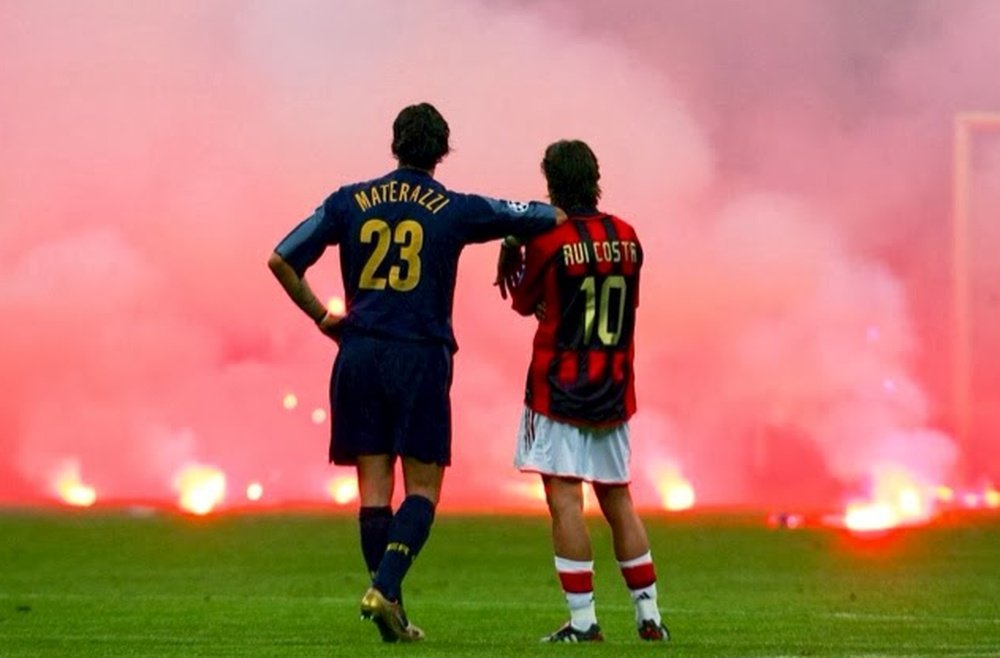
In any case, it would take something special to usurp the most iconic Milan derby picture – that of Marco Materazzi and Rui Costa watching the flares that led to the 2004-05 Champions League quarter-final to be abandoned. However, that image is, in some ways, the antithesis of what we’d expect in a local derby.
Around world, cross-town rivals tend to contrast in colour choice, often with one plumping for red and the other for blue. In that regard, Milan is like Bristol, Buenos Aires, Liverpool, Manchester, Munich or Sheffield, to name but a few examples. That in turn means that, by and large, that the sides can face each other in their primary kits.
There are some incidents when derbies require changes – in 1985-86, Arsenal wore yellow away to Tottenham Hotspur as the home side had white shorts that season and the Gunners didn’t have a red alternative set for their home kit; less easy to understand was in 2012-13, where Tottenham decided to wear a third kit at Emirates Stadium.
The stripes of Newcastle and Sunderland can prove troublesome sometimes, while, when Bayern Munich had a navy home kit from 1997-99, they still used a special red strip against neighbours 1860. In the Milan derby, the dark kits worn by Milan and Inter in 2016-17 led to the Rossoneri becoming the Bianchi in their ‘away’ game at San Siro.
There had been isolated instances of change prior to that – 1992-93 was one – but 2004-05 represented a particularly jarring example.
The league games between the clubs – a 0-0 draw in October and 1-0 win for Milan in February – were straightforward, albeit with the ‘away’ team switching to white shorts and socks.


Then, after Milan beat Manchester United in the last 16 of the Champions League and Inter overcame Porto, the quarter-finals brought them together – a repeat of the semi-finals of two years previously.
That Inter-Porto tie foreshadowed what was to come, as both legs featured the two clubs in change kits, all-white for Inter and all-navy for Porto.
Part of the reason for that was that the Nerazzurri had opted to use their navy and grey hooped third shirts as the first-choice outfit for Europe, as in the successful 1997-98 Uefa Cup campaign. And, rather than pairing those jerseys with light shorts and socks for the quarter-final first leg away to Milan, instead they used the white change kit. Milan’s only deviation from the domestic kit was the Uefa-mandated panel for the numbers.


A 2-0 win for Milan on April 6 put them firmly in control ahead of the second leg a week later, as well as ensuring that away goals would not be the determining factor, as they had been in 2003.
Few could have predicted just how things would play out, though – not least on the kit front. Whether or not Inter made a request to wear their proper kit in a game of such magnitude, we don’t know, but they took to the field in the European strip – a third different shirt that season against Milan, who made it four games in red and black shirts against their rivals, again donning white shorts and socks.


Andriy Shevchenko’s goal had Milan 1-0 up on the night and 3-0 in front on aggregate, so they would surely have seen out the victory even without the ‘flair’ shown by the Inter fans.
That input led to the famous picture, of course – and the fact that Inter’s shirts had hooped torsos but vertical stripes on the sleeves means that, from behind, the casual observer might think Materazzi was in the traditional colour-scheme.